Is that how far I am behind on uploading my photos, really? Have I really not uploaded anything since Brisbane!?
I am making amends now - starting at the end, instead of the beginning (as all blogs should - when they're behind at least).
My 'photostream' on Flickr can be found here
I have been considering writing info and comments on the photos themselves rather than attempting to work them into blog entries (which obviously hasn't been happening) - I think I will give that a try.
Don't ask how convenient it will be for the viewer, I don't have that much experience with Flickr. But I encourage you to try it out! There's some photos of wonderful places in there.
--------
@JohnSBaxter
2009-traveldiary.blogspot.com
2009-motorcyclist.blogspot.com
Showing posts with label outback. Show all posts
Showing posts with label outback. Show all posts
Saturday, October 3, 2009


Saturday, September 26, 2009
Westward Bound and onto a new leaf in the NT: deliverance in a land of promise
Retrospective: a story to fill the gap between Cairns and Alice.
Leaving Cairns was a busy few days: reef cruise one day, mountain climb the next, heading west (and some caving) the day after that. Pretty hectic and I was buggered - SO much did I enjoy hitting the open road. I don't need rest - riding is my tonic.
The road to Chillagoe - with its semi-above-ground limestone caves - pushed no buttons, for a number of reasons (like traffic and dust). The road out of it pushed buttons alright, but not the right ones! The stretch was one of those country dirt roads that just flows over the undulations of the landscape, no matter what they may be. All very well, except in tropical country relatively flat ground is intersperced by subtle floodways and dry rivers - subtle, that is, until you run into one. It looks as though the road slopes into a gentle dip like the four or five you have just passed through - it is not until you are on the cusp of it that you realise the centre of the dip drops out, and it takes another moment (a panic-riddled moment) to work out what greets you at the bottom of it. Many of these contain craters left by the huge forces of road trains blasting through them - on two occasions I was caught out and rode straight through battlefields no sane road rider would wish to attempt. The second was the more dramatic - I hit a bump on the way down (within that panic-riddled moment), hard on the brakes, violent enough to blur my vision which meant I only had long enough to confirm that the dip was dry - but seated with a set of deep ridges. Throttle on at the last minute, and as both ends bottomed out with a huge clunk the bike skittled over and washed out almost off the edge of the (staight) roadway on the other side. That, however, was nowhere near as intimidating as the one before: a gentle hill descended at the last minute into a murky puddle. And not a concrete bottomed puddle, but a sand-bottomed bike swallowing one! Hard on both brakes - handlebars flapping, rear end dragging through the deep, moist sand that lined the last ten metres before an expected over-the-handlebars wet-and-wild flying trip. By some miracle the tyres pulled through, and the sand proved grippy enough for me to pull up with a good metre or two to spare.

That deep channel towards the right is my hitting the soft stuff.
It might sound like I was going too fast - but at 70km an hour, on 160km of dead straight - largely well-surfaced - dirt, it felt like I was crawling. The dips just drop away so suddenly that no margin of safety will cover you completely. After the third adventure I made a policy of virtually stopping at the crest of any dip that I couldn't absolutely confirm the extent of. It felt ridiculous, but I got through from there without drama.

So pleased to see tar...
From there! Well the road got better before it got worse - and that it got. Less surprises, true, but rough as guts. My destination ended up Bourketown - you know, famous for the Morning Glory clouds? Well, the clouds never came, and I got over Bourketown very, very quickly indeed for a range of reasons... More testing dirt under the belt and I was back onto the highway which would take me Westward through Cloncurry and Isa.
Cloncurry on a Sunday proved little more lively than Bourketown, but Isa on the Monday was a pleasant change - friendly for a mining town, and a good opportunity to get stuff done.
I got talked out of taking the back road to Alice (and for the better - I spoke to a guy who rode through there on his dirtbike who confessed to binning it a handful of times - god knows how well I'd have faired), so onward it was along the tar - hardly complaining for that, with the beauty of the country around Isa.
Soon enough I was in the NT and onto a new leaf in a new land.
Tennant Creek proved a nice little stop - it's only a small town, sure, with a sad former significance as a mining town (every town besides Isa seems to have had the same stories of grandeur and excitement long passed), but with a positive outlook and a great community spirit.
The road from there to Alice I've already written about in reverse (it's great!), and Alice - well you've gotten Alice - so I suppose I've filled that hole. (Though I confess to being overly brief.)
--------
@JohnSBaxter
2009-traveldiary.blogspot.com
2009-motorcyclist.blogspot.com
Leaving Cairns was a busy few days: reef cruise one day, mountain climb the next, heading west (and some caving) the day after that. Pretty hectic and I was buggered - SO much did I enjoy hitting the open road. I don't need rest - riding is my tonic.
The road to Chillagoe - with its semi-above-ground limestone caves - pushed no buttons, for a number of reasons (like traffic and dust). The road out of it pushed buttons alright, but not the right ones! The stretch was one of those country dirt roads that just flows over the undulations of the landscape, no matter what they may be. All very well, except in tropical country relatively flat ground is intersperced by subtle floodways and dry rivers - subtle, that is, until you run into one. It looks as though the road slopes into a gentle dip like the four or five you have just passed through - it is not until you are on the cusp of it that you realise the centre of the dip drops out, and it takes another moment (a panic-riddled moment) to work out what greets you at the bottom of it. Many of these contain craters left by the huge forces of road trains blasting through them - on two occasions I was caught out and rode straight through battlefields no sane road rider would wish to attempt. The second was the more dramatic - I hit a bump on the way down (within that panic-riddled moment), hard on the brakes, violent enough to blur my vision which meant I only had long enough to confirm that the dip was dry - but seated with a set of deep ridges. Throttle on at the last minute, and as both ends bottomed out with a huge clunk the bike skittled over and washed out almost off the edge of the (staight) roadway on the other side. That, however, was nowhere near as intimidating as the one before: a gentle hill descended at the last minute into a murky puddle. And not a concrete bottomed puddle, but a sand-bottomed bike swallowing one! Hard on both brakes - handlebars flapping, rear end dragging through the deep, moist sand that lined the last ten metres before an expected over-the-handlebars wet-and-wild flying trip. By some miracle the tyres pulled through, and the sand proved grippy enough for me to pull up with a good metre or two to spare.
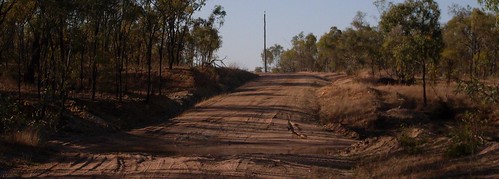
That deep channel towards the right is my hitting the soft stuff.
It might sound like I was going too fast - but at 70km an hour, on 160km of dead straight - largely well-surfaced - dirt, it felt like I was crawling. The dips just drop away so suddenly that no margin of safety will cover you completely. After the third adventure I made a policy of virtually stopping at the crest of any dip that I couldn't absolutely confirm the extent of. It felt ridiculous, but I got through from there without drama.
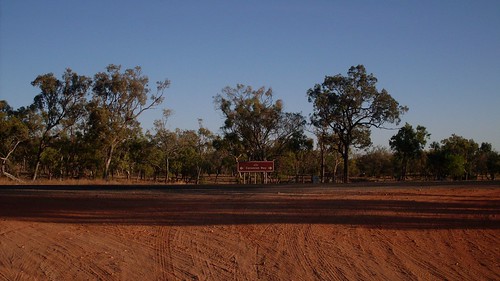
So pleased to see tar...
From there! Well the road got better before it got worse - and that it got. Less surprises, true, but rough as guts. My destination ended up Bourketown - you know, famous for the Morning Glory clouds? Well, the clouds never came, and I got over Bourketown very, very quickly indeed for a range of reasons... More testing dirt under the belt and I was back onto the highway which would take me Westward through Cloncurry and Isa.
Cloncurry on a Sunday proved little more lively than Bourketown, but Isa on the Monday was a pleasant change - friendly for a mining town, and a good opportunity to get stuff done.
I got talked out of taking the back road to Alice (and for the better - I spoke to a guy who rode through there on his dirtbike who confessed to binning it a handful of times - god knows how well I'd have faired), so onward it was along the tar - hardly complaining for that, with the beauty of the country around Isa.
Soon enough I was in the NT and onto a new leaf in a new land.
Tennant Creek proved a nice little stop - it's only a small town, sure, with a sad former significance as a mining town (every town besides Isa seems to have had the same stories of grandeur and excitement long passed), but with a positive outlook and a great community spirit.
The road from there to Alice I've already written about in reverse (it's great!), and Alice - well you've gotten Alice - so I suppose I've filled that hole. (Though I confess to being overly brief.)
--------
@JohnSBaxter
2009-traveldiary.blogspot.com
2009-motorcyclist.blogspot.com
Saturday, September 19, 2009
Alice: A Red Heart more than mere stones
ODO 88 500
Firstly, wow. Or as I've been finding myself gasping this afternoon - 'Wow. Fucken wow.'
Secondly, Alice rocks.
As you will read, or will have read, the Stuart Highway into Alice from the north is a great ride. Arriving in Alice itself though is no major spectacle. The rocky outcrops that dot the town, or jut out into 'the Gap', are peculiar, but far from spectacular. They're... rocky outcrops! It's when you head West (or perhaps East) that you realise the beauty of the Macdonell Ranges of which they are a part.
Now, I'm no rock man (normally a tree guy....), but the sheer geology of this place is astounding. There is more variation in 100km of the Macdonell's than in 1000km of Great Dividing Range. That impression might be as much due to the presentation - which if staged could only be described as impeccable, or better yet divine. This is the outback, and the only thing which is completely regular is the inclination of the road, so it might be misleading to think in terms of perfection and fallability.
Not far West out of Alice, as the valley opens up and the range bears itself to view you can see exactly why the Tjikurpa (Dreamtime) story ascribes the ranges to caterpillars. A bit further on you find yourself exclaiming 'now THAT is how to do a rocky outcrop!'. Then a eucalypt-lined 'river' bed, and before you know it you're turning off towards the national park.
The new valley the road meanders up is - despite one's disbelief - even more beautiful than the first. It's here that you are struck with awe at the geology behind this range, the immense violence the rocky ranges represent. Layers of sedementary rock thrust themselves vertically into the sky as ridges beside the road. At the Ghost Gum lookout you read about the different layers of rock that make up the gorge below, and how the top layer (about 100m tall) previously resided 2km to the north.
The geological forces have been weathered by rivers like the Finke, 'possibly' the oldest in the world at around 100 million years, not that it often looks much like a river. The 'semi-permanent' waterholes hidden among gaps in the ranges really allow you to feel the word 'oasis' in a way that no definition ever will.
And the trees... ah yes no landscape can really excell without some beautiful trees... the weathered, wry old souls out here have their backs turned to the winds of time just as everything else does. 'If they could talk...' the cliche goes - you would probably have to sit and wait a while, because the long stories they have to tell, they would be in no hurry to part with.
And that was just a short trip on a Friday afternoon!
I'd heard positive things about Alice - from people that have lived there. Nobody else that has passed through has had much to say about it. I am bemused as to why not. Far and away, it has been my favourite stop of the trip so far.
As I had heard, Alice doesn't have a high proportion of long-term residents. It isn't temporary like Cairns is - the tourists were really quite thinly spread while I was there - but everybody you speak to (or at least all the young people) can count the number of times they've seen the Todd run on the one hand (2.5/year, apparently). The abundance of the 'new' local makes the whole scene immensely approachable, though everybody has their own explanations of the town's charms. Many look outwards, to the town's desert surrounds - whether it is a communal love of the outback, or the sense of isolation.
Another perk is the town's surprising cosmopolitan feel. It only has 20k people! But it has more life than most towns of five times that size. So many people I spoke to arrived in Alice expecting a quiet life, but found themselves busier than ever. Whether it's the music, the art, the sporting or environmental events - there is a deep layer of community activity which is more reminiscent of uni than a regional hub. The Aboriginal aspect to the town is so much more savoury than in many other places. There is a synthetic vaneer to the tourist operations of Todd st, but the next street over there are galleries which don't have 'Aboriginal Art' plastered on the outside, because when it isn't marketted to the tourist dollar the label gives way to its conversation with contemporary art more generally.
Alice is closer to Newtown than Bourketown, and I can assure you that can not be a bad thing.
If you're looking to get away then you could do a lot worse than coming to Alice.
--------
@JohnSBaxter
2009-traveldiary.blogspot.com
2009-motorcyclist.blogspot.com
Firstly, wow. Or as I've been finding myself gasping this afternoon - 'Wow. Fucken wow.'
Secondly, Alice rocks.
As you will read, or will have read, the Stuart Highway into Alice from the north is a great ride. Arriving in Alice itself though is no major spectacle. The rocky outcrops that dot the town, or jut out into 'the Gap', are peculiar, but far from spectacular. They're... rocky outcrops! It's when you head West (or perhaps East) that you realise the beauty of the Macdonell Ranges of which they are a part.
Now, I'm no rock man (normally a tree guy....), but the sheer geology of this place is astounding. There is more variation in 100km of the Macdonell's than in 1000km of Great Dividing Range. That impression might be as much due to the presentation - which if staged could only be described as impeccable, or better yet divine. This is the outback, and the only thing which is completely regular is the inclination of the road, so it might be misleading to think in terms of perfection and fallability.
Not far West out of Alice, as the valley opens up and the range bears itself to view you can see exactly why the Tjikurpa (Dreamtime) story ascribes the ranges to caterpillars. A bit further on you find yourself exclaiming 'now THAT is how to do a rocky outcrop!'. Then a eucalypt-lined 'river' bed, and before you know it you're turning off towards the national park.
The new valley the road meanders up is - despite one's disbelief - even more beautiful than the first. It's here that you are struck with awe at the geology behind this range, the immense violence the rocky ranges represent. Layers of sedementary rock thrust themselves vertically into the sky as ridges beside the road. At the Ghost Gum lookout you read about the different layers of rock that make up the gorge below, and how the top layer (about 100m tall) previously resided 2km to the north.
The geological forces have been weathered by rivers like the Finke, 'possibly' the oldest in the world at around 100 million years, not that it often looks much like a river. The 'semi-permanent' waterholes hidden among gaps in the ranges really allow you to feel the word 'oasis' in a way that no definition ever will.
And the trees... ah yes no landscape can really excell without some beautiful trees... the weathered, wry old souls out here have their backs turned to the winds of time just as everything else does. 'If they could talk...' the cliche goes - you would probably have to sit and wait a while, because the long stories they have to tell, they would be in no hurry to part with.
And that was just a short trip on a Friday afternoon!
I'd heard positive things about Alice - from people that have lived there. Nobody else that has passed through has had much to say about it. I am bemused as to why not. Far and away, it has been my favourite stop of the trip so far.
As I had heard, Alice doesn't have a high proportion of long-term residents. It isn't temporary like Cairns is - the tourists were really quite thinly spread while I was there - but everybody you speak to (or at least all the young people) can count the number of times they've seen the Todd run on the one hand (2.5/year, apparently). The abundance of the 'new' local makes the whole scene immensely approachable, though everybody has their own explanations of the town's charms. Many look outwards, to the town's desert surrounds - whether it is a communal love of the outback, or the sense of isolation.
Another perk is the town's surprising cosmopolitan feel. It only has 20k people! But it has more life than most towns of five times that size. So many people I spoke to arrived in Alice expecting a quiet life, but found themselves busier than ever. Whether it's the music, the art, the sporting or environmental events - there is a deep layer of community activity which is more reminiscent of uni than a regional hub. The Aboriginal aspect to the town is so much more savoury than in many other places. There is a synthetic vaneer to the tourist operations of Todd st, but the next street over there are galleries which don't have 'Aboriginal Art' plastered on the outside, because when it isn't marketted to the tourist dollar the label gives way to its conversation with contemporary art more generally.
Alice is closer to Newtown than Bourketown, and I can assure you that can not be a bad thing.
If you're looking to get away then you could do a lot worse than coming to Alice.
--------
@JohnSBaxter
2009-traveldiary.blogspot.com
2009-motorcyclist.blogspot.com
Subscribe to:
Posts (Atom)

 Posts
Posts

